Why Time Management Fails When You're Overcommitted
If you feel overcommitted, it's rarely because you don't manage your time well enough.
Most people who reach this point already plan carefully. Calendars are full. Tasks are prioritised. Focus time is blocked out. And yet the pressure keeps returning.
I know this because I've lived it. As someone who defaults to saying yes, who genuinely wants to help, who finds it easier to stretch a little further than to disappoint someone, I spent years believing I just needed a better system. More discipline. Tighter scheduling. A more sophisticated way of tracking what needed to get done.
None of it worked for long. And eventually I realised why.
Overcommitment is usually not a time problem. It's a timing problem.

Timing, not time - a critical distinction
The difference between time and timing
Time management focuses on quantity: how many hours you have, how many tasks fit into a day, how efficiently you can move through them.
Timing focuses on conditions: when your thinking is clear, what kind of work fits the energy you actually have, what costs more than it looks like on paper.
This distinction sits at the heart of my Timing, Not Time series (you can watch the first reel here, and it explains why overcommitment persists even in organised lives.
Where the real problems hide

A still from my reel entitled Timing, Not Time
Work expands to fill whatever space you give it. Tasks grow, meetings run long, small requests multiply. This isn't poor discipline. It's a known effect, and time-based planning doesn't account for it.
Estimates stay optimistic even when you know better. Not because you're careless, but because conditions change. Interruptions, context switching, emotional load, the wrong kind of work at the wrong moment. Time plans don't handle this well.
Different work needs different conditions. Deep thinking needs quiet and clarity. Reactive work thrives on momentum. Emotional labour draws from a different reserve altogether. When everything is treated as interchangeable, effort increases and clarity fades. You can be perfectly on schedule and completely depleted.
And then there's the invisible weight of unfinished work. Open loops don't stay neatly contained. Unfinished tasks take up mental space. Deferred decisions keep negotiating with you in the background. At some point, the load is no longer visible in your calendar. It's carried internally.
How overcommitment actually builds
It rarely comes from one big decision. It builds through small yeses, quick replies, helpful instincts, a habit of stretching a little further than you should. By the time you notice, you're already compensating.
For people pleasers especially, this pattern is almost invisible while it's happening. Saying yes feels like the path of least resistance. The cost only becomes clear later, usually when you're too tired to do the thing you actually needed to protect time for.
This is where timing matters more than time. The most useful question becomes: what do I actually have capacity for? Not what could fit. Not what feels expected. What is genuinely available.
What capacity planning changes
Capacity planning shifts attention away from hours and toward rhythm. It looks at where energy actually went, what boundaries held or slipped, what felt heavier than expected, what became easier with practice.
Ten minutes a week is enough if the questions are right. The aim isn't control. It's clarity.
And awareness on its own doesn't change much. The moment that matters is when you see the same pattern repeat and act once. One boundary. One decision. One adjustment to how the next month is planned. That's usually enough to start reducing the load.
Why I built the Calm Capacity Kit
I created the Calm Capacity Kit because noticing patterns isn't enough on its own.
Most people can see they're overcommitted. What's harder is knowing what to do next without turning it into another system to maintain.
The Calm Capacity Kit is a four-week personal capacity planning reset for people who consistently take on more than they have capacity for. It focuses on energy rather than time, helps you see what repeats, and supports one clear decision at a time.
It's not a planner. It's not a journal. It's a decision support tool.
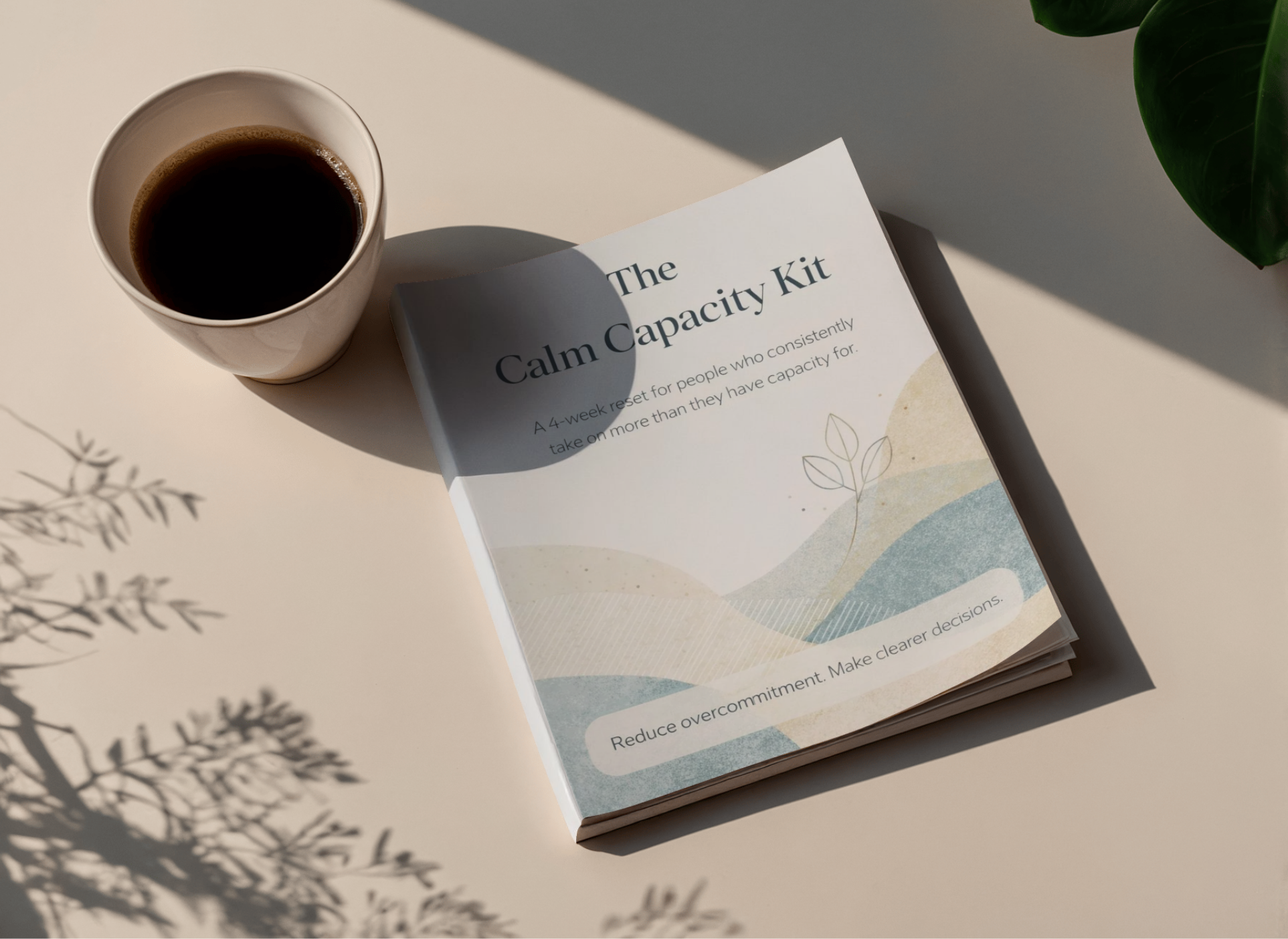
The Calm Capacity Kit
If you take one thing from this
At the end of the week, ask yourself one question: what cost me more than I expected?
That answer usually tells you where the next boundary belongs. And if you want a simple, structured way to work with that question over four weeks, the Calm Capacity Kit is there when you're ready.