Why I Switched to Simple Analytics (And Removed Google Analytics From My Sites)

There is a moment, when you are trying to operate an ethical digital practice, where you realise the gap between what you say and what your setup actually does. For me, that moment was looking at Google Analytics sitting quietly on the backend of my websites while I wrote publicly about data sovereignty and the right to privacy. It had to go.
The problem with Google Analytics
Google Analytics is free. That sentence contains the entire problem. The data it collects (IP addresses, device details, browser configurations, location, behaviour) flows to Google's servers in the United States. Under the CLOUD Act, American authorities can compel Google to hand that data over regardless of where the original visitor was sitting when they loaded your page.
This is not hypothetical. Austria ruled Google Analytics illegal in January 2022. France, Italy, Denmark, Finland, Norway and Sweden followed. France's CNIL ordered websites to comply within a month. Sweden's IMY fined Tele2 approximately one million euros for continued use of the tool. Regulators across the EU determined that data was being transferred without adequate protection, with specific concerns about US intelligence agencies accessing European users' personal data.
The legal picture shifted somewhat when the EU-US Data Privacy Framework was adopted in 2023. It may shift again. Max Schrems, who brought the cases that killed the previous two frameworks, has said publicly he doubts this one survives the current US administration. The previous two did not survive legal challenge. There is no particular reason to assume this third one will.
Running Google Analytics from a consultancy in France, writing about ethical technology, was not a position I could ignore.
Fathom
Fathom Analytics was the first move. No cookies. No personal data. No fingerprinting. No consent banner, because there is nothing requiring consent.
Fathom pseudo-anonymises IP addresses using a hashing and salting process. The result is a session identifier that cannot be traced back to anyone. EU visitor data routes through EU servers automatically, through what Fathom calls EU Isolation, built specifically in response to the Schrems II ruling. French visitors stay in France. It happens without configuration.
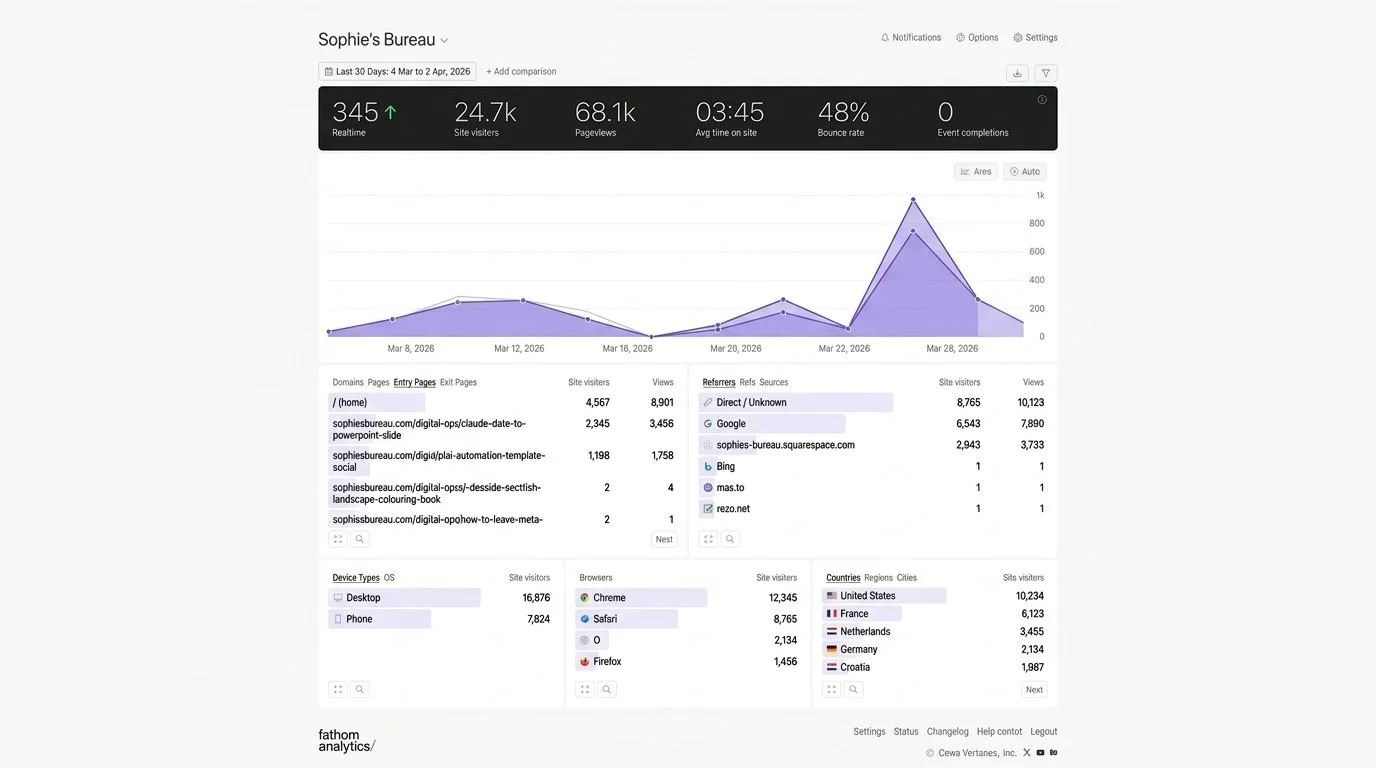
The Fathom Analytics dashboard - one page, everything you need. Visitors, pageviews, referrers, countries, browsers, and top pages.
The dashboard is one page. Visitors, page views, referrers, top content, geography, bounce rate, time on site. That is everything. After years inside GA4's interface, which seems designed to obscure rather than reveal, the simplicity of Fathom felt almost suspicious. Like something was missing. Nothing was missing.
Fathom also has no limit on the number of sites. You pay for total pageviews across all of them, not per site. For anyone managing more than two or three websites, this is ideal. On Plausible, the Growth plan covers three sites. On Fathom you just keep adding.
I used Fathom. I liked Fathom. Then I looked at where it was incorporated.
The jurisdiction question
Fathom is a Canadian company. Canada holds GDPR adequacy status, which means EU data transfers are legally sound. The EU Isolation feature means EU visitor data doesn't leave EU servers. On paper, defensible.
But when two tools are equally simple to use, jurisdiction becomes the deciding factor. Simple Analytics is incorporated in the Netherlands. Its servers are in the Netherlands. Your data never leaves the Netherlands and therefore never leaves the EU. No adequacy decision to depend on. No routing architecture to understand. An EU company, governed by EU law, full stop.
The simplicity of the two tools is genuinely equivalent. One dashboard. Visitors, referrers, top pages, countries. A date picker. Both load fast. Both require less than ten minutes to set up. Both are cookieless, collect no personal data, and need no consent banner. When the tools are equal and one is inside the EU and one is outside it, the choice is not difficult.
Simple Analytics has a free tier. Data history on the free plan is capped at 30 days, which is enough to try it properly on a real site before committing. Paid plans start at €15 per month and cover up to 10 sites.
The limitations
Simple Analytics' Starter plan covers 10 sites. If you manage more than that, the Team plan is $40 per month for up to 20 sites. The numbers climb from there.
Fathom's model is genuinely better for web designers with larger client portfolios. It offers up to 50 sites, with additional sites available for a fee. If you are managing 15 or 20 sites and want costs to stay predictable, Fathom is the more practical choice. The ethical gap between them is real but not dramatic. Fathom's architecture holds up. Its EU Isolation feature addresses the main concern. For a single site or a small number of sites, Simple Analytics is the cleaner choice. For a large portfolio, Fathom makes more financial sense.
Setting it up
Simple Analytics generates a small script. You paste it into your site's header. On Squarespace: Settings, Advanced, Code Injection. It takes about 5 minutes. The script is light and has no meaningful effect on page load.
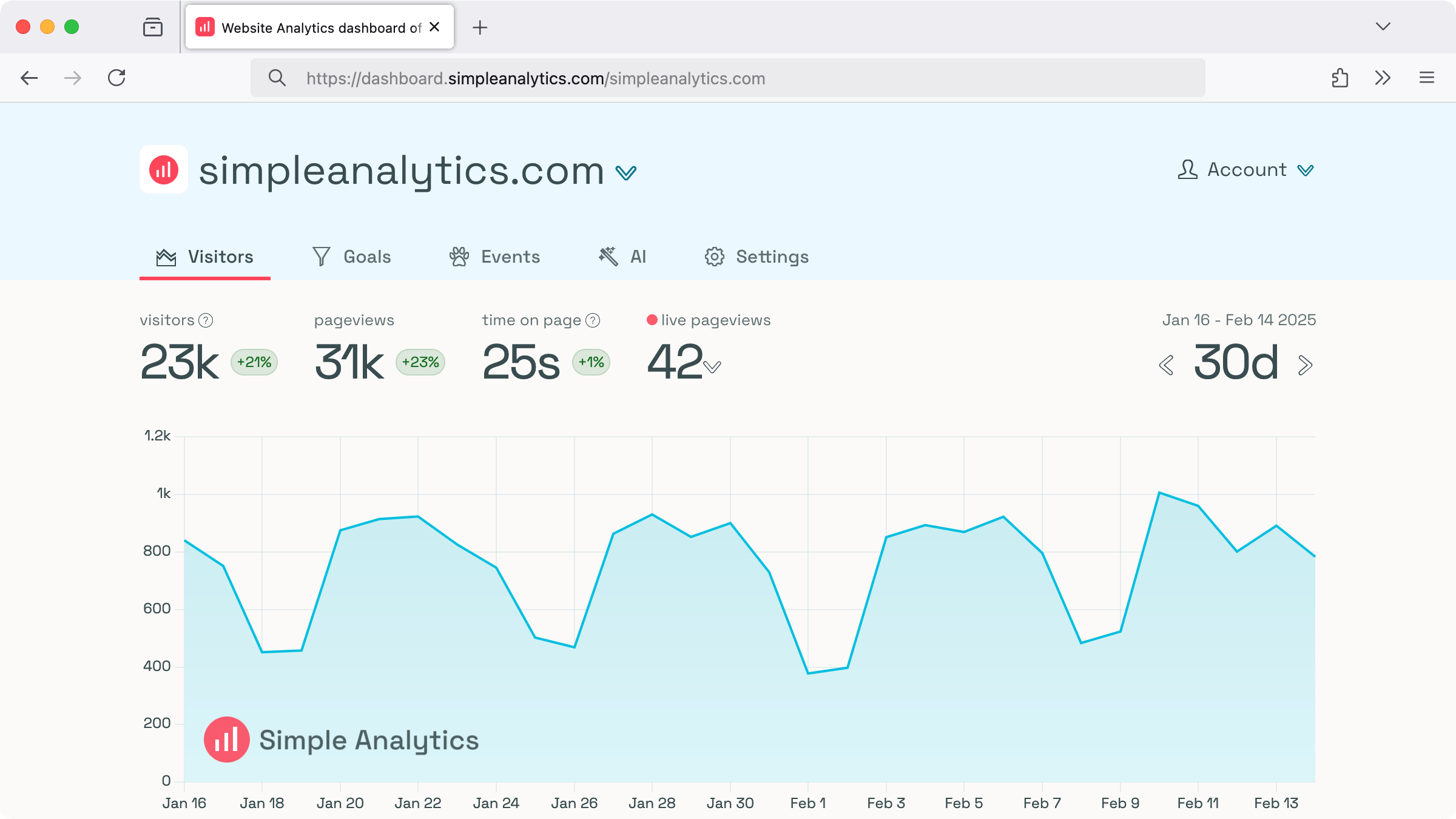
The Simple Analytics dashboard. Visitors, pageviews, time on page, live views.
Simple Analytics offers a Google Analytics data import - you will see the option on your dashboard when you first log in. Your historical data can come with you, which means you are not starting completely from scratch. Search Console and Google Analytics are different products. Removing GA from your site does not affect your Search Console data or your search performance tracking - Search Console continues working independently.
The move towards more ethical, privacy-focused tech
This is one move in a sequence. Proton Mail replaced Gmail. Brave replaced Chrome. Mastodon and Pixelfed replaced Instagram, Facebook and LinkedIn. Claude replaced ChatGPT and Comet Browser. Mistral replaced Perplexity. None of these are large individual acts. The accumulation is the point.
Simple Analytics is not open source. There is no public code to audit. You are trusting the company's published privacy commitments. That trust rests on their track record since 2018, on the fact that their entire business model depends on not doing what Google does, and on the unusual transparency of publishing their revenue and costs publicly. It is not verification. It is trust based on evidence. That is the position with most tools.
The 14-day trial requires no credit card. Try it on one site first. The answer will come quickly.
| Tool | HQ | Ethical Score | Simplicity | Pricing | Sites | Cookieless | Best For |
|---|---|---|---|---|---|---|---|
| Google Analytics | USA | ★☆☆☆☆ | ★★☆☆☆ | Free | Unlimited | No | Those comfortable handing visitor data to Google's US servers |
| Simple Analytics My pick | EU (Netherlands) | ★★★★★ | ★★★★★ | Free / from €15/mo | Up to 10 (Simple plan) | Yes | Single site owners and small agencies wanting full EU jurisdiction with maximum simplicity |
| Fathom Analytics | Canada | ★★★★☆ | ★★★★★ | From $15/mo | Up to 50 | Yes | Web designers and agencies managing many sites who need high site coverage |
| Plausible | EU (Estonia) | ★★★★★ | ★★★★☆ | From €9/mo | 1–3 (Starter/Growth) | Yes | Single-site owners wanting EU jurisdiction, open source, and the lowest entry price |
| Matomo Cloud | New Zealand | ★★★★☆ | ★★★☆☆ | From €19/mo | Up to 30 | Yes | Organisations needing GA-level depth: funnels, heatmaps, session recording |
| Matomo Self-Hosted | New Zealand | ★★★★★ | ★★☆☆☆ | Free + server costs | Unlimited | Yes | Technical users wanting maximum data sovereignty; data never leaves your server |
Ethical score reflects jurisdiction, data practices, cookieless architecture, and independence from advertising infrastructure. Simple Analytics and Plausible score highest as managed services — both are EU-incorporated with EU-only data. Matomo self-hosted scores highest overall: your data physically never leaves your own server. Fathom's Canadian jurisdiction holds EU adequacy status; EU Isolation keeps EU visitor data on EU servers. Google Analytics collects personal data, transfers it to US servers, and its business model is built on using that data for advertising.