How a Free Tool Became a Paid Product (And Why It Took AI and a Human to Build It)
I've had a binaural beats generator on this site for a while. Find Your Frequency. You pick a scenario, put on headphones, and it plays you the tones. Free, no account, works in a browser. I built it because I was curious about the audio technology and because I like making things that work.
I originally built it for myself so I didn't have to keep looking up routines and frequency values every time I wanted to listen. Then other people started using it, which I hadn't really planned for.
Around the same time I started reading more of the research. Not the vague wellness internet stuff about sound healing everything, but actual published studies about what happens to your body when you're chronically stressed and sleeping badly. The cortisol pathways that trigger breakouts weeks after the stress that caused them. The growth hormone that gets released during deep sleep and drives collagen synthesis. The measurable decline in skin barrier function after even a single night of poor rest. Published, peer-reviewed, the kind of findings you can actually look up and read for yourself.
And binaural beats, it turns out, have a small but real evidence base for reducing cortisol and supporting deeper sleep. Not as strong as the skin research. Still developing. But enough published studies from enough different groups that the connection felt worth taking seriously.
Find Your Frequency already had guided routines and a concern picker. It wasn't just a raw generator. But it was built for a general wellness audience, framed around general concerns rather than skin, and sitting on a consultancy website where the context was wrong for the people who'd benefit most from the skincare connection. The gap was between a free tool that happened to be useful for skin and a dedicated product that made that connection explicit, backed it with cited research, and gave it a brand that the right audience could find and trust,
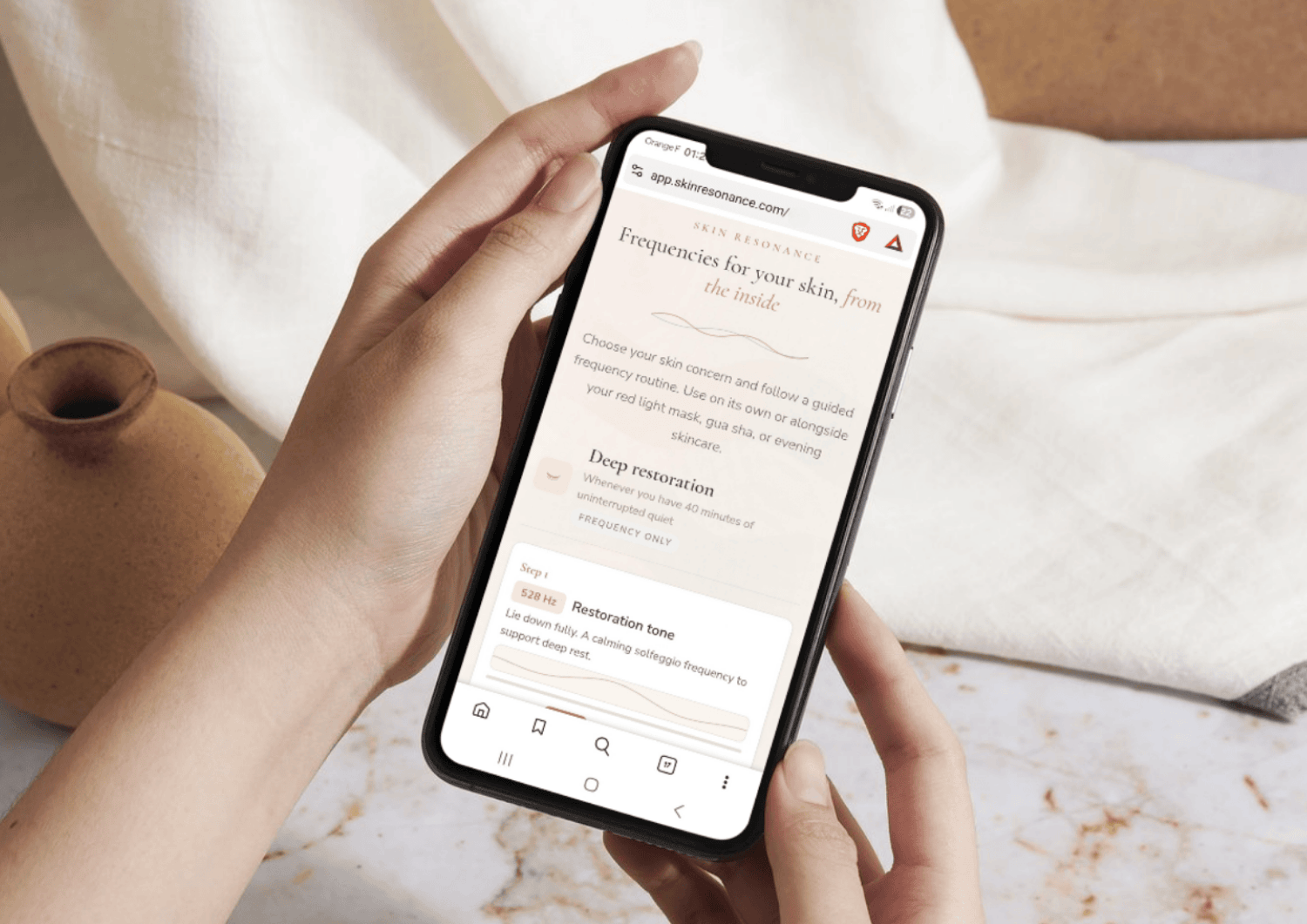
The finished product. Nine routines, a custom builder, and an audio engine I couldn't have written myself.
So I built Skin Resonance. Twelve guided routines, a custom builder, five ambient soundscapes, animated waveform visualisations, session logging with personal notes, and skincare tool timing. A science page that cites eight peer-reviewed studies and is transparent about what the evidence supports and where the gaps are. Two journal articles tracing specific pathways: cortisol and breakouts, delta sleep and collagen. A free trial of one routine so people can feel the thing before buying it. €15. One-time. No subscription.
I should talk about how it got made, because that's probably why you're reading this.
I am not a developer. I can read code and I can tell when something is wrong and I can adjust CSS and troubleshoot DNS records and do all the things that come from years of building websites and systems for clients. What I cannot do is write a Web Audio API implementation from scratch. The audio engine in Skin Resonance generates real binaural beats through properly separated stereo channels, mixes in brown noise via a random walk algorithm, runs solfeggio tones through amplitude modulation with a low-frequency oscillator, and routes everything through tuned low-pass filters. That's specialist audio programming. I didn't write it.
Claude wrote it. Claude wrote all of it. The audio engine, the routine logic, the waveform animations, the soundscape crossfading, the responsive layouts, the SVG icons, the deployment configuration, the schema markup. If you've read my pieces on using Claude for email signatures or building PowerPoint slides from data, this is the same working relationship taken to a place I didn't know it could go.
The whole thing was built in roughly a week of concentrated sessions. Not one marathon. A series of conversations that kept building on each other, each one picking up where the last one left off, each one producing something that I could test and listen to and react to before directing the next round.
Without AI, this product either doesn't exist or it takes months and costs thousands in developer fees. The audio engine alone would have been a significant commissioning project, with the usual friction of explaining what you want to someone who has their own ideas about what you need. I wrote about my full AI stack earlier this year. Skin Resonance is the most thorough test of that stack to date.
Claude wrote the code. I made every other decision.
I chose the frequencies. Not by asking Claude to suggest them. By reading the research, listening to existing binaural beat tracks from producers, testing different carrier frequencies against each other through headphones while lying on my bed in the evening, and deciding what sounded right and what the evidence supported. The 108 Hz carrier for the Schumann resonance frequency (a nod to 432 Hz tuning, if you're into that). The specific brown noise mix levels for each frequency, adjusted because some felt warmer at slightly higher concentrations. The decision to use amplitude modulation on the solfeggio tones but not on the binaural beats, because the pulsing serves a different purpose in each context and smooth binaural beats recede into the background better over long sessions. The final step of every routine now fades to silence over ninety seconds rather than stopping abruptly, because I fell asleep during a test session and woke up when the audio cut off.
These are taste decisions. They come from listening, from research, from opinions about what kind of experience I wanted the product to create. No AI made them. No AI could have made them, because they required me to lie there with my eyes closed and notice that the soundscapes were too quiet at the default volume, or that all the waveform animations were moving when only the active step should be animated, or that the fade-in time needed to be longer so people weren't startled.
I designed the brand. Clay and sage. Cormorant Garamond. Concentric circles with a sine wave. The positioning as "sound-led skincare support" rather than "binaural beats for beauty" (because the first is more accurate and the second is marketing). The decision to name specific journals on the science page rather than hiding behind "backed by research." The evidence disclaimers that appear on every page that makes a claim, because the sound frequency space is full of people overclaiming and I didn't want to be one of them.
I wrote the content, or more precisely, I directed and heavily edited the content. Claude can produce text. What it cannot do without very specific instruction is avoid the constructions I can't stand reading. Every sentence in both journal articles was read and either approved or flagged and rewritten. The AI generates. The human curates. If you skip the curation step you get content that sounds like content. I wanted writing.
I gave Find Your Frequency away because it's a tool. It lives on this site, it shows what I can build, it gives people something useful. That's what it's for.
Skin Resonance costs money because it solves a specific problem for a specific person. The routines are sequenced around physiological responses. The research is cited. The free trial lets you experience the thing in your body, not just read about it on a page. That took work, and the work has value, and pricing it at zero would have been a statement about how I value my own work rather than a generous act toward the buyer.
€15 for twelve routines, a custom builder, five soundscapes, session logging, skincare tool timing, and all future updates. Launch price, because the product will grow.
I put it on its own domain with its own brand identity because a buyer searching for sound frequency skincare should not land on a digital operations consultancy. That separation took more effort than just adding a page here. It also forced cleaner thinking about who the product is for and what it needs to say to them. Easier isn't always right.
Some things I'd do differently if I started again tomorrow.
Analytics from day one. I shipped without any tracking, which means the first wave of visitors arrived, looked around, and left, and I have no data about what they did or where they dropped off. Every subsequent decision has been made without that information. I should have followed my own SEO advice and set this up before anything went live.
Journal articles written a month before launch, not the week of. Search indexing takes weeks. Content that will eventually drive organic traffic was invisible on launch day. If those articles had been live and indexed before the product existed, they'd have been pulling people in from Google on day one.
Email lead magnet built into the signup from the start, not added as an afterthought. A newsletter form that says "join for updates" converts at a fraction of the rate of one that says "get a free printable evening routine." The routine PDF should have been ready before the form went live.
If you're reading this and you're a consultant or a coach or a solo operator who has something you give away that could be a product, the tools to build it are here. The technical barrier to shipping a polished digital product as a non-developer is lower right now than it has ever been, and it's dropping fast.
The harder question is whether you can direct the build. Whether you know your subject well enough and trust your own taste enough to make the hundreds of small decisions that turn a free tool into something worth paying for. The AI writes the code. You decide what the code should do, and how it should feel, and whether it's good enough. Both sides are necessary. Neither works alone.
Skin Resonance took a week to build. It took longer than that to think about. The thinking is the product. The code is just how it got out of my head and onto someone's phone.
Skin Resonance is live. You can try a free 10-minute routine. Find Your Frequency remains free.
If you're thinking about building a digital product and want help with the operations, systems, or Squarespace side of it, book a free consultation.